Your photo under the Milky Way on an Atacama stargazing tour
Every one of the five stargazing tours we compare sends you home with some kind of picture of yourself under the stars. Most take one portrait per person, while one runs a full photo session. Below, what each listing promises, how the shot is made, and what your own phone can manage.
What each tour gives you to take home
The photo is part of the fare on all five nights, though the listings describe it in different words. Most promise a single professional shot, while one runs a whole session.
| Tour | Photo on the listing | From |
|---|---|---|
| The Roofless AI (AtacamaTours) | One professional photo per person, plus tips for phone shots of the stars | ~$70 |
| Llama Stargazing | A photo with the stars (astrophotography in the inclusions) | ~$33 |
| Una Noche Con Las Estrellas | A professional astrophoto | ~$46 |
| Owner Experience | A professional night photo session | ~$50 |
| Observatorio Licanatay | A free photo under the stars, sent by email | ~$36 |
None of the listings we read gives a delivery time. Ask on the night how and when the file reaches you, and check that the guide has your email or phone number right.
How the portrait under the stars is made
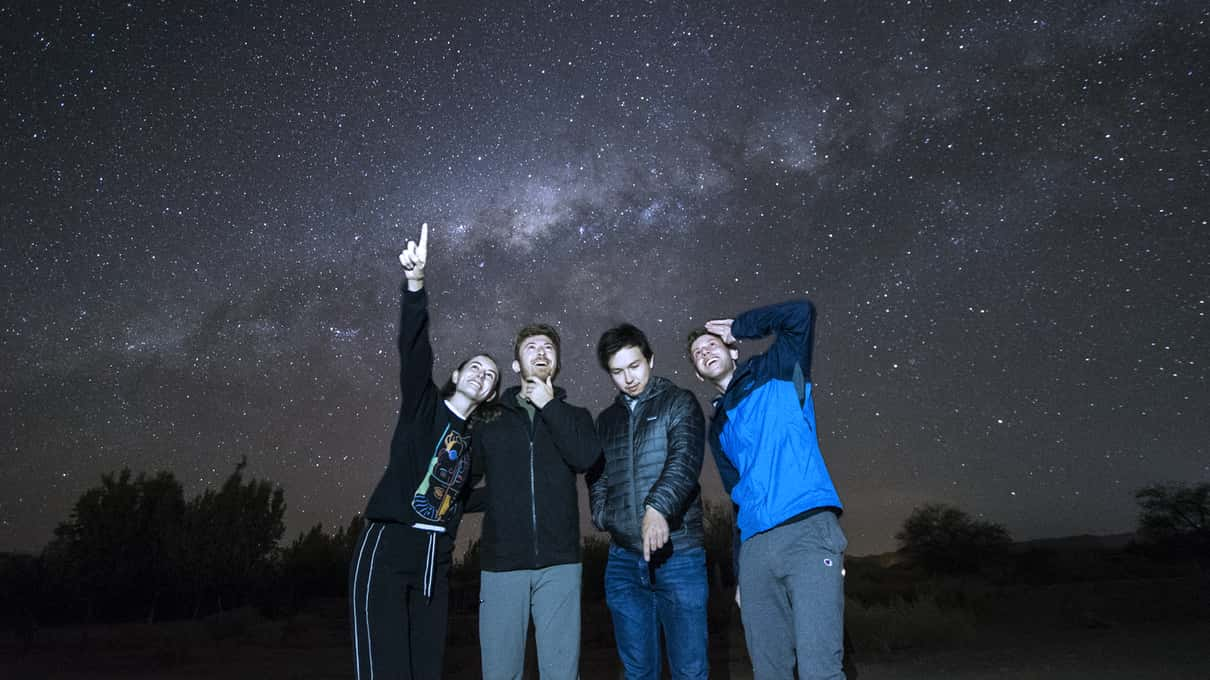
A camera on a tripod keeps its shutter open for several seconds, long enough to gather the faint glow of the Milky Way. During that time you stand still, and the guide lights you briefly with a lamp so your face shows against the sky.
Any movement turns you into a soft blur while the stars behind you stay crisp. Pick a pose you can hold, such as an arm pointing at the Southern Cross, and breathe slowly.
Groups tend to take turns, so the photo stop takes a while. Use the wait to let your eyes settle and to look up at the sky with nothing in your hands.
Phone shots of the sky
Recent phones have a night mode that gathers several seconds of light into one picture. It works far better when the phone does not move, so set it on a small tripod or wedge it firmly against your bag.
The Roofless AI's guides give tips for phone photos of the stars, so arrive with a charged battery. Cold drains batteries fast; carry a power bank in an inside pocket.
- Turn the flash off; it lights only the sand in front of you
- Dim the screen, so you keep your night vision and do not dazzle the people next to you
- Tap to focus on a bright star or the Moon, or set focus to infinity if your camera app allows it
- Use the timer, so pressing the button does not shake the frame
- Take several frames; the first one is rarely the keeper
A phone shows the Milky Way as a pale band, at times brighter than your eye sees it, since the sensor collects light for longer. Do not expect the deep colors of professional astrophotography.
Red light and good manners at the telescopes
A white phone screen or flashlight resets everyone's dark-adapted eyes in a second. The Una Noche tour holds its coffee break under red lights for this reason, and it skips campfires because they spoil night vision.
Use a red headlamp, and step away from the group when you check your pictures. Flash on someone else's face at a stargazing site is never welcome, so ask before you point a lit phone at anyone.
A lesson with a picture at the end
Una Noche Con Las Estrellas teaches you to find your way by the stars, under red lights and with hot spiced wine, then takes a professional astrophoto of you. Its vehicle drops you at your hotel afterward.
How the Moon changes the picture
A bright Moon washes out the Milky Way in a photo as much as in the sky. The portrait still works, but the background turns a paler blue with far fewer stars.
Because The Roofless AI skips the brighter half of the lunar cycle, its photos come from darker nights. For the others, check a lunar calendar; our Moon guide shows how to plan around it.
The Moon itself makes a good phone picture through a telescope. Hold the phone lens close to the eyepiece and move slowly until the bright disc fills the screen, but ask the guide first, since a bumped telescope ends everyone's view.
The bright core of the Milky Way rides high overhead from about May to September. In December and January it sits low or has already set in the evening, which our guide to the best months covers in more depth.
Which tour for which kind of photo
If the picture matters most, Owner Experience gives it the most room, with a professional night photo session inside a 3-hour tour. Owner Experience from ~$50 also picks you up, which spares you carrying a tripod through dark lanes (see our pickup guide).
For one good portrait at the lowest fare, Llama Stargazing from ~$33 includes a photo with the stars. Observatorio Licanatay from ~$36 emails a free picture, and The Roofless AI from ~$70 adds phone tips to its portrait.
Pictures taken through an eyepiece rarely match the view. Our guide to what the telescopes show sets fair expectations for faint clusters and galaxies.
Dressing for a slow photo
Standing still for a portrait, then fiddling with a phone in the open, chills you quickly. Gloves that work on touchscreens help, and so does a warm hat that stays on for the picture.
Nights are cold all year at this altitude, and coldest from June to August. Our what to wear guide lists the full set of layers.