Clouds, cancellations and refunds on Atacama stargazing tours
Most nights over San Pedro de Atacama are clear, but not all of them. A cloudy evening raises two questions, whether the tour still runs and whether you get your money back. The answers depend on who calls it off, how late, and the policy on your listing.
How often clouds get in the way
Clouds are the exception here, since few deserts are drier, but they do happen. For most of the year a cloudy night in San Pedro is the exception rather than the rule.
The riskiest stretch is the altiplanic winter, also called the Bolivian winter, from about January to March. That is when summer moisture builds storm clouds over the mountains east of town, mainly in January and February.
Even then many nights clear after sunset, and some evenings bring only thin high cloud. Our guide to the best months sets the cloud risk against cold and darkness through the year.
When the operator cancels
On a fully overcast night, the operator decides whether the tour runs. If it is called off for weather, you normally get the choice of a refund or a new date, but the exact terms belong to each listing.
We do not know each company's internal rules, so we will not invent them here. Read the cancellation policy on the listing before you pay, and ask the operator through the partner's messages if anything is unclear.
Booking through GetYourGuide or Viator keeps the payment and the refund inside one platform. If a tour is cancelled and the money does not come back, you contact the partner's customer service rather than chasing a small local office.
When you cancel yourself
On every listing we read you can cancel for free until 24 hours ahead, and GetYourGuide spells this out for Llama Stargazing. Check yours, because policies can differ between options and between the two partners.
That 24-hour line is the one that matters for weather. If the forecast looks grim the day before, you can cancel or move your night for free. On the day itself, a change of mind usually costs you the full price.
Partial cloud is a different night
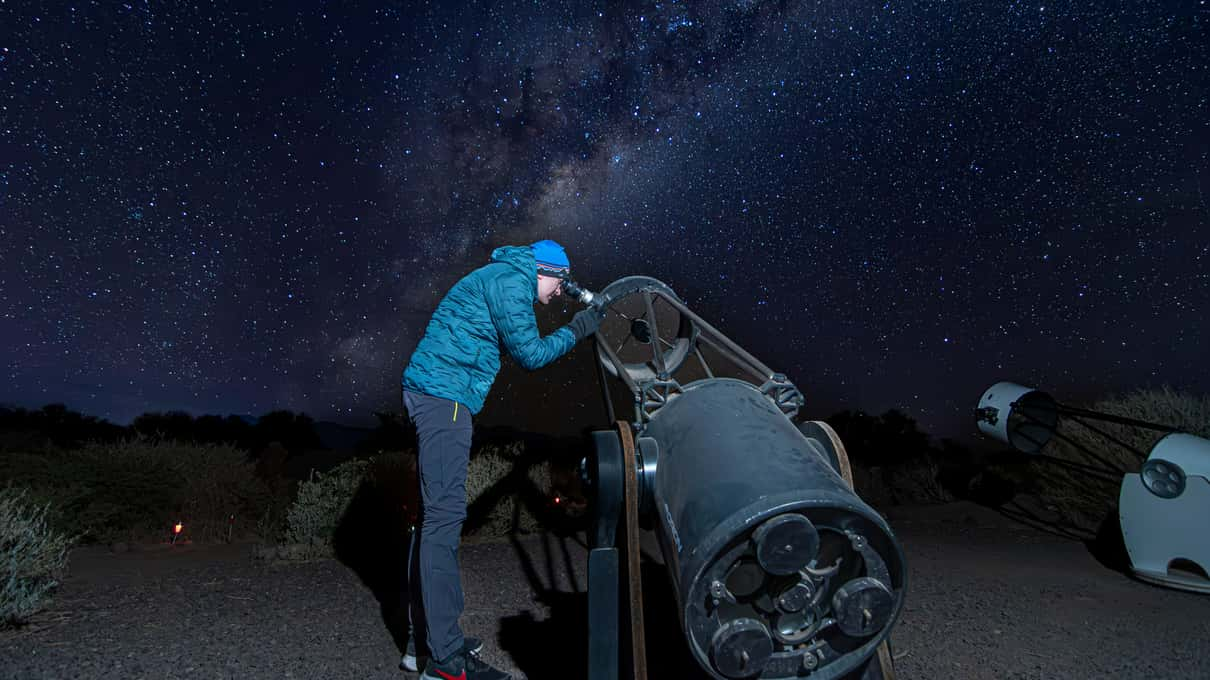
Scattered cloud rarely stops a tour. The guides work the gaps, swinging the telescopes to whatever patch of sky is open, and a bright planet or the Moon can show through thin haze.
What suffers most are the faint targets, such as the dust lanes of the Milky Way and the dim galaxies. Our guide to the night sky through the telescopes explains which objects survive a hazy night and which disappear first.
Reading the sky before you go
A general weather app gives a rough idea, and cloud-cover forecasts made for astronomers give a better one. Neither is reliable hours ahead in the mountains, so treat them as a hint rather than a verdict.
The simplest test is to look west at sunset. A clean horizon over the desert is a good sign, while a heavy bank of cloud over the Andes in the late afternoon is a warning, especially in summer.
Your guide knows the local patterns better than any app. If you are unsure, message the operator in the afternoon and ask how the evening looks.
Two kinds of sky in one night
Observatorio Licanatay pairs modern astronomy with the way Andean peoples read the Milky Way, and gives you a poncho against the cold. It holds 4.7 from 800+ reviews, on GetYourGuide only.
What a hazy night still gives you
A tour that goes ahead under some cloud is not a write-off. The talk under the open sky still happens, and the guides tell the stories behind the constellations whether or not every star is showing.
The extras stay the same too. Hot drinks, snacks and the night photo are part of most tours here, and a guide can still take your portrait against whatever sky is open.
If the gaps close completely, ask the guide what the operator offers. Some will suggest another night, but that is their call and depends on the listing, so do not count on it.
The Moon cancels nights too
Clouds are not the only thing that removes dates. The Roofless AI tour from ~$70 does not run when the Moon is more than half lit, so in bright weeks its calendar simply has fewer slots.
Other tours run under a bright Moon and shift their focus to the Moon and planets. The Observatorio Licanatay night from ~$36 tells you on its listing to check the lunar calendar first, and gratuities are not included there. Our guide to the Moon explains the trade-off.
Plan a spare night
The single best defense against clouds is time. Book your stargazing tour early in your stay, on the second or third evening, and leave at least one later night free.
If the first night clouds over, you can rebook through the partner, or take the operator's new date if it cancels. With free cancellation up to 24 hours ahead on the listings we read, holding a second night costs little.
Price differences between tours are small next to the cost of a lost night, so compare them in our stargazing price guide and pick the dates first. If you are still torn between options, our premium or budget comparison helps you choose.
Cold and clouds often come together in a trip plan. A night that clears late can turn very cold, so dress as our guide to dressing for the desert night suggests even when the forecast looks mild.