How the Moon changes an Atacama Desert stargazing tour
A bright Moon is the one thing in the Atacama sky that every tour listing warns about. It does not cancel the night, but it changes what the telescopes can show and which tours run at all. This page explains what moonlight takes away, what it leaves and how to pick your dates.
What moonlight does to a dark sky
A full Moon lights the desert so well that you can see your shadow on the sand. That glow spreads across the whole sky and drowns the faint light of the Milky Way, the nebulae and the distant galaxies.
A thin crescent barely matters. From about half lit upward, the glow turns the deep black over the Atacama Desert into a pale grey-blue, and the Milky Way fades to a faint stripe or vanishes.
The Atacama is one of the driest places on Earth, and observatories are built in the region because its skies are clear and dark. Moonlight is the one kind of light pollution nobody can switch off.
What still works on a bright night
The Moon itself is one of the finest sights in a telescope. Near the line between light and shadow its craters and mountains stand out sharply, and the grey plains look close enough to walk on.
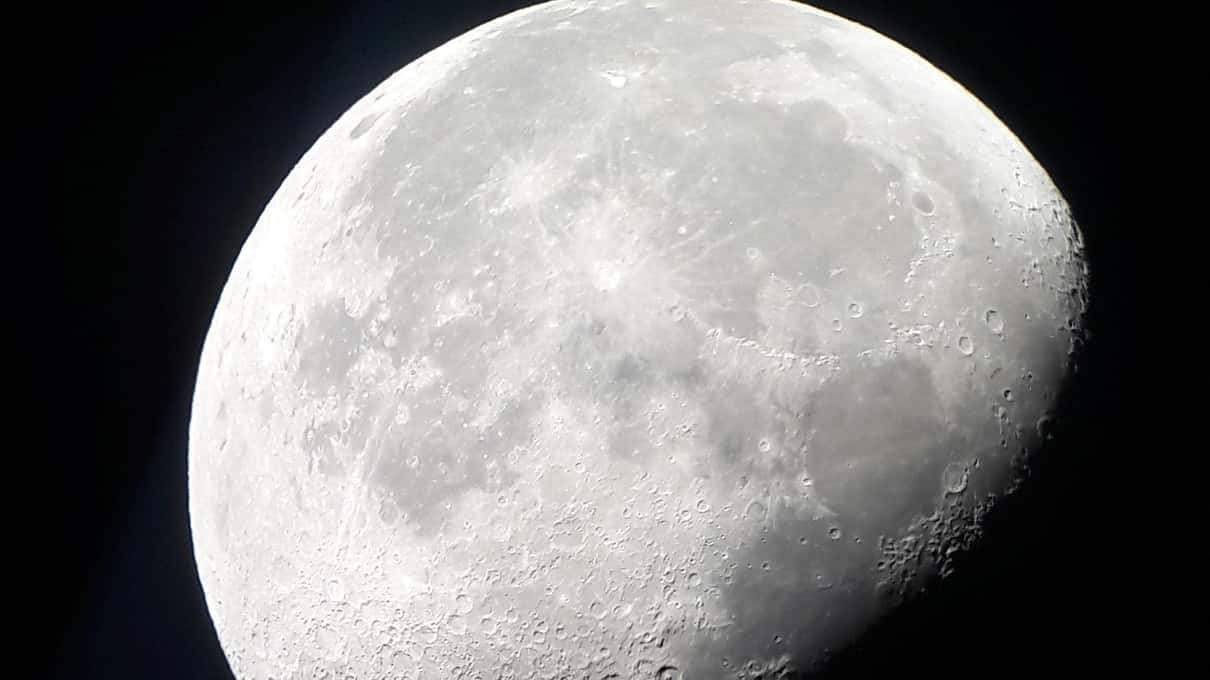
Planets cope well with moonlight because they are bright. Saturn's rings and Jupiter's moons show clearly when those planets are up, which depends on the time of year, so no tour can promise them.
Bright double stars and some star clusters also hold up. What suffers are the faint, spread-out targets, the glowing gas clouds and the galaxies beyond our own.
The 50% rule on our top pick
The Roofless AI by AtacamaTours (~$70) has the strictest rule here: no tour once the Moon passes half lit. Its two 16-inch motorized telescopes are there to pull in faint objects, and the operator would rather skip a night than show them washed out.
For you, that means fewer dates. In the bright half of each lunar month the calendar has gaps, so a short stay near full Moon may not line up with it at all.
For the dark half of the month
The AtacamaTours night with its big twin telescopes, a door-to-door van and a photo for everyone. Dates appear only when the Moon is under half lit.
If a date does show, you can count on a darker sky than on a random night. Our premium or budget guide weighs that against cheaper nights that run all month.
How the other four tours handle it
Every listing on this site says moonlight cuts what you see. Llama Stargazing (~$33) goes further and mentions a moon and planets version for bright nights, with the details on the listing.
Observatorio Licanatay (~$36) tells guests to check the lunar calendar before booking. Its Andean astronomy part leans on the dark shapes inside the Milky Way, which fade badly under a bright Moon.
Una Noche Con Las Estrellas and Owner Experience also warn that moonlight limits the view. Learning to find your way by the stars works on any night, which softens a bright evening on the teaching tour.
Making the most of a moonlit tour
If your only free evening falls near full Moon, go anyway and adjust what you hope for. The guide will lean on the Moon and the planets, and the stories behind the constellations work under any sky.
Moonlight has its own rewards in the desert. The landscape stays visible around you, and the cone of Licancabur can stand out against the sky above San Pedro.
A bright night can also suit families, since children see a big, sharp Moon at once instead of waiting for faint smudges. Our page on stargazing with children covers the other things that help a family night.
Reading a lunar calendar
Any lunar phase calendar shows the new Moon, the quarters and the full Moon. The darkest nights fall in the few days either side of the new Moon, when the Moon stays close to the Sun and out of the night sky.
Timing matters as much as the phase. A waxing Moon is already up at dusk and sets later each evening, while a waning Moon rises after dark, roughly 50 minutes later each day.
That opens a useful window after full Moon. A few days later the first hours of darkness come before moonrise, which is when most tours are out at the telescopes.
A half-lit Moon in the evening sky sets around midnight, and a half-lit Moon after full rises around midnight. The same phase can mean a bright or a dark tour depending on which side of full Moon it falls.
Planning your dates around the Moon
Once you know the phase for your trip, a few habits keep the odds on your side. They cost nothing and take a minute before you book.
- Check the phase for your travel dates before you choose a tour
- Book the darkest night early in your stay, so a cloudy evening leaves time to try again
- On a bright week, pick a tour that still runs and enjoy the Moon and planets
- Look at moonrise times as well as the phase, since a late moonrise leaves the first hours dark
- Expect fewer AtacamaTours dates in the bright half of the month
The season matters too, since the bright core of the Milky Way rides high from about May to September. Our best months guide sets the Moon against the time of year, and our page on clouds and refunds covers the other risk.
Moonlight also changes the souvenir picture most tours take of you. Our Milky Way photo guide explains why the band of stars behind you is clearest on a dark night.