What the telescopes show you in the Atacama night sky
A night under the Atacama sky starts with your own eyes and ends at the eyepiece. Some objects look better than you expect and some far smaller, and knowing which is which saves a little disappointment. This guide goes through what you are likely to see, in the order most tours show it.
First, the sky with no telescope
Every tour here begins with the lights off and heads tilted back. Away from the town glow, the sky over the Atacama Desert holds so many stars that familiar patterns can be hard to pick out at first.
The Milky Way is the band you came for. On a dark night it shows as a pale river with knots of light and dark gaps, brightest toward its core, which rides high overhead from about May to September.
Satellites cross it as slow, steady points of light, often several in the first hours after dark. Guides usually point them out, along with the odd meteor if you are lucky.
Give your eyes time. Full dark adaptation takes around 20 to 30 minutes, and one glance at a white phone screen undoes much of it, which is why guides ask for red lights only.
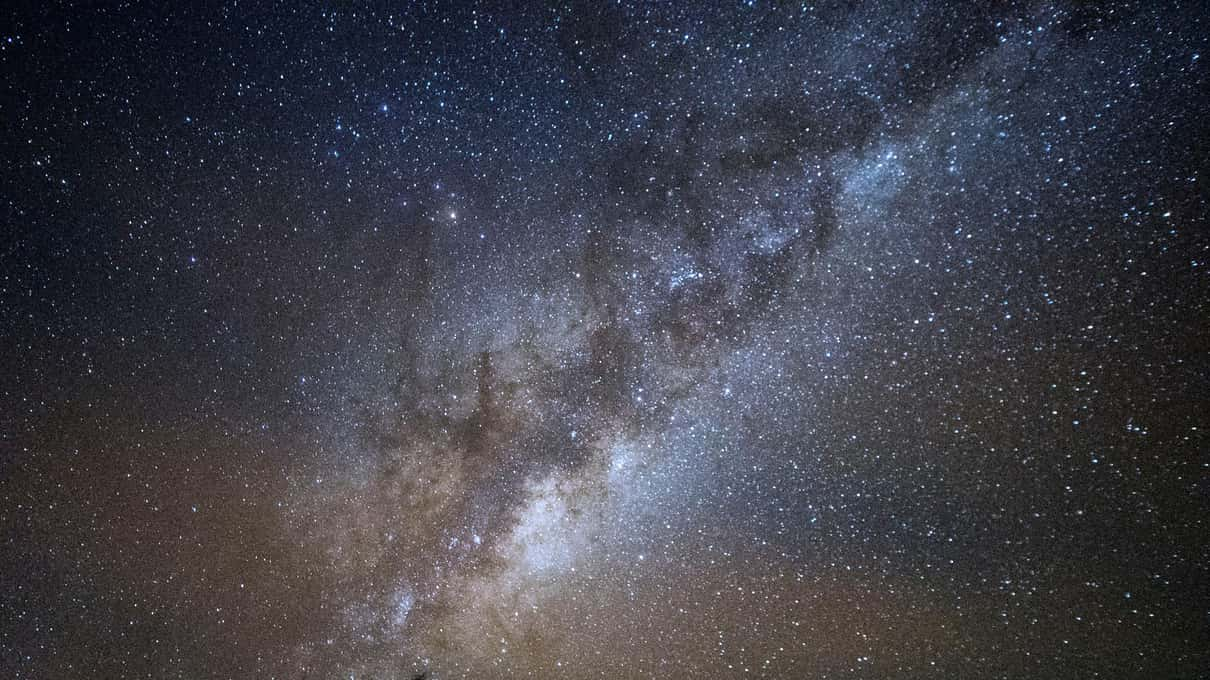
Landmarks of the southern sky
Visitors from the north meet new stars here. The Southern Cross is small and kite-shaped, and beside it sits the Coalsack, a dark cloud of dust that blocks the stars behind it.
The two Magellanic Clouds look like detached scraps of the Milky Way. They are small companion galaxies of our own, and seeing them with the naked eye is one of the rewards of a southern night.
Andean cultures read the dark lanes of dust as well as the stars. Shapes such as the llama sit inside the Milky Way, and these dark constellations are often the part of the night people remember.
Planets in the eyepiece
Through a telescope, Saturn is the object that draws the loudest reaction. The rings are clear even at modest power, though the planet looks small, a sharp cream-colored toy rather than a poster.
Jupiter shows its cloud bands and up to four moons lined up beside it. Both planets come and go with the seasons, so whether they are up on your night depends on the date.
Guides often teach a simple test before the telescopes come out. Stars twinkle, while planets shine with a steadier light, because they show a tiny disk rather than a point.
Bright stars repay a look as well. In a telescope they stay points however large the instrument, but some show clear colors, from blue-white to deep orange, that the naked eye barely registers.
The Moon, clusters and nebulae
When the Moon is up, it fills the eyepiece with craters, mountains and grey plains. Our guide to moonlight explains why that same Moon makes faint objects harder to see.
Star clusters are among the most satisfying targets. Open clusters scatter a few dozen bright stars across the view, and globular clusters look like a ball of fine sugar that a bigger telescope starts to break into single points.
Double stars add color. Some pairs show two different tints side by side, often gold and blue, which the eye picks up far more easily than any tint in a nebula.
Nebulae, the glowing clouds of gas, appear as soft grey patches with some shape. The color you know from photos builds up over long exposures, so the eye sees little of it.
Galaxies, and what to expect
Galaxies beyond our own appear as faint smudges, often small and grey-white. They need a dark sky and a patient eye, and the thrill comes from knowing their light left them millions of years ago more than from the view.
The same holds across the night. Apart from the planets, the Moon and the brightest stars, most views are small and pale, and nothing like the colored images from space telescopes.
That is fine once you expect it. The scale of the open sky usually stays with people longer than any single eyepiece view, and our photo guide shows how to bring some of it home.
How Una Noche Con Las Estrellas teaches the sky
Una Noche Con Las Estrellas (~$46) builds the evening as a lesson. A coffee break under red lights gives your eyes time to adjust, and the operator skips campfires because their glare spoils night vision.
The guides show how to find the cardinal points by the stars and trace the ecliptic, the path the Sun and planets follow across the sky. They also cover the life cycle of stars, with professional telescopes for looking at examples.
For a night that explains the sky
Una Noche Con Las Estrellas' teaching tour with red-light breaks, professional telescopes, hot spiced wine and an astrophoto. You meet at Plazuela Apacheta and get dropped at your hotel.
Groups are split by language with no translation, and the tour rates 5.0 from 300+ reviews on Viator. Expect more lesson than party, which suits curious minds better than anyone after a social evening.
Three telescopes, two big ones and Andean stories
Owner Experience (~$50) brings three telescopes. The computerized one is aimed at the planets and the Moon's craters, and a wide-field one frames nebulae and clusters.
Observatorio Licanatay (~$36) starts with modern astronomy and then turns to how Andean peoples read the sky. Its dark constellations are tied to animals, water, the seasons and farming, a different way of seeing the same Milky Way.
AtacamaTours (~$70) puts two 16-inch telescopes on the field, which gather more light for faint targets. Our premium or budget guide weighs that against the price, and the best months guide covers when the Milky Way core is up.